CrashDump Sherlock Walkthrough
Analyzing a user-mode process dump of a Cobalt Strike beacon: PEB/thread analysis, named pipe IOCs, and injected shellcode with WinDbg and minidump.
Solved CrashDump from Hack The Box!
A suspicious executable was identified running on one of the compromised endpoints. Initial triage suggests that this process may have been leveraged by the threat actor to establish a foothold on the system. To support further malware analysis and behavioral reconstruction, a user‑mode process dump of the suspected executable has been provided.
| Field | Value |
|---|---|
| Category | DFIR |
| Difficulty | Easy |
| Status | Completed |
| Date | 2026-03-27 |
| Stack | Notepad.DMP and update.DMP |
| Tools | Windbg, minidump |
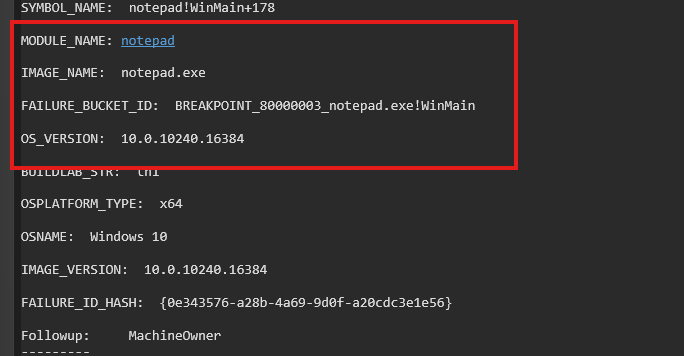
Q1 — Provide the operating system version.
Answer 10.0.10240.16384
I opened notepad.DMP in WinDbg and ran the !analyze -v command. WinDbg is a Windows debugger developed by Microsoft that can analyze memory dumps, crash dumps, and minidumps. It provides detailed information about the system state at the time of the dump, including loaded modules, thread stacks, exception records, and OS version details.
Q2 — Provide the full path of the malicious executable used to gain initial access.
Answer C:\Users\s1rx\Downloads\update.exe
To answer this question I used minidump from Python on both notepad.DMP and update.DMP. I started looking at the PEB (Process Environment Block) info to find the full path of the malicious executable. The answer was found in update_all.txt — the ImagePath field reveals the full path.
#The command I use
$ minidump notepad.DMP --all > notepad_all.txt
$ minidump update.DMP -- all > update_all.txt

$ cut update_all.txt

PEB ADDR: 0x7ff5ffff6000
BeingDebugged: 0
ImageBaseAddress: 0x400000
ProcessParameters: None
ImagePath: C:\Users\s1rx\Downloads\update.exe
CommandLine: "C:\Users\s1rx\Downloads\update.exe"
WindowTitle: C:\Users\s1rx\Downloads\update.exe
DllPath:
CurrentDirectory: C:\Users\s1rx\Downloads\
StandardInput: 0
StandardOutput: 65537
StandardError: 0
EnvironmentVariables:
        =::=::\
Q3 — How many threads did the malicious process use?
Answer 6
By using minidump update.DMP --threads I found 6 threads running under the malicious process. Multiple threads in a process like update.exe is suspicious — Cobalt Strike uses additional threads for tasks like beacon callbacks, pipe communication, and post-exploitation jobs.
$ minidump update.DMP --threads

# minidump 0.0.24
# Author: Tamas Jos @skelsec (skelsecprojects@gmail.com)

ThreadList
ThreadId | SuspendCount | PriorityClass | Priority | Teb
-------------------------------------------------------------------
0xbdc    | 0            | 32            | 0        | 0x7ff5ffffd000
0x3ec    | 0            | 32            | 0        | 0x7ff5ffff9000
0xa14    | 0            | 32            | 0        | 0x7ff5ffff7000
0xe30    | 0            | 32            | 0        | 0x7ff5ffff4000
0x448    | 0            | 32            | 0        | 0x7ff5ffffb000
0x8      | 0            | 32            | 0        | 0x7ff5ffece000
Q4 — Provide the named pipe (IPC channel) used by the malicious process.
Answer MSSE-1641-server
First, I extracted all strings from both dump files in ASCII and Unicode format. I always do this as a first step with memory dumps to avoid missing any evidence — Windows stores some strings in ASCII and others in Unicode (UTF-16LE), so both passes are necessary.
$ strings -a notepad.DMP > notepad_ascii_strings.txt
$ strings -a -el notepad.DMP > notepad_unicode_strings.txt
$ strings -a update.DMP > update_ascii_strings.txt
$ strings -a -el update.DMP > update_unicode_strings.txt
Then I searched all extracted strings for named pipe references:
$ grep -i '\\pipe\\' *_strings.txt | sort -u
Results
| File | Pipe | Type |
|---|---|---|
update_ascii_strings.txt |
\\.\pipe\MSSE-1641-server |
Cobalt Strike SMB Beacon |
update_unicode_strings.txt |
\\.\pipe\postex_3d6e |
Cobalt Strike post-exploitation pipe |
notepad_unicode_strings.txt |
\??\pipe\postex_2326 |
Cobalt Strike post-exploitation pipe |
| Various | \pipe\epmapper, \pipe\svcctl, \PIPE\winreg |
Normal Windows services |
The MSSE-1641-server pipe stands out as the primary IPC channel. The name mimics “Microsoft Security Essentials” (MSSE) to appear legitimate,
but it is the default Cobalt Strike SMB Beacon named pipe used for peer-to-peer communication between compromised hosts over SMB.
Q5 — Provide the PID of the injected process. Provide the Answer in decimal.
Answer 2336
notepad.exe is the injected process, as it was targeted by update.exe for shellcode injection. To extract its PID we read the MiscInfoStream from the minidump:
$ minidump notepad.DMP --misc
# minidump 0.0.24
# Author: Tamas Jos @skelsec (skelsecprojects@gmail.com)

== MinidumpMiscInfo ==
ProcessId 2336
ProcessCreateTime 1762304686
ProcessUserTime 0
ProcessKernelTime 0
ProcessorMaxMhz 3793
ProcessorCurrentMhz 3793
ProcessorMhzLimit 3793
ProcessorMaxIdleState 1
ProcessorCurrentIdleState 1
Q6 — At what time was the last thread created for the injected process? Provide the timestamp in UTC.
Answer 2025-11-05 01:09:12
To list all threads and their creation timestamps:
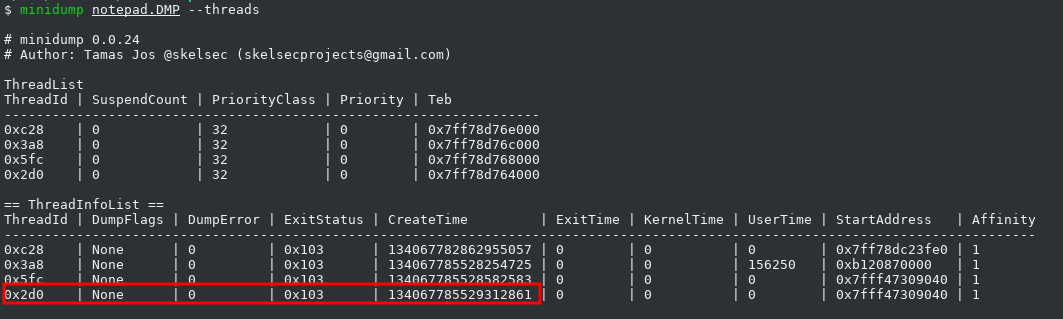
The thread list includes creation times as Windows FILETIME values — 64-bit integers counting 100-nanosecond intervals since January 1, 1601 UTC. Taking the latest timestamp and converting to UTC:
python3 -c "import datetime; ft = 134067785529312861; epoch = datetime.datetime(1601,1,1); delta = datetime.timedelta(microseconds=ft//10); print(epoch + delta)"
2025-11-05 01:09:12.931286
Q7 — Provide the BaseAddress of the injected shellcode.
Answer b120870000`
To find the shellcode we scan notepad.DMP memory regions for the PAGE_EXECUTE_READWRITE + MEM_PRIVATE combination — the classic IOC for injected code:
PAGE_EXECUTE_READWRITE— memory that is readable, writable, and executable simultaneously. Legitimate code is normally either writable (during load) OR executable (during run), never both at the same time.MEM_PRIVATE— not backed by any file on disk. Legitimate DLLs appear asMEM_IMAGE. Private executable memory with no backing file is anomalous.
$ minidump notepad.DMP --memory | grep PAGE_EXECUTE_READWRITE
BaseAddress    | AllocationBase | AllocationProtect | RegionSize     | State       | Protect                | Type
0xb120870000   | 0xb120870000   | 64                | 0x1000         | MEM_COMMIT  | PAGE_EXECUTE_READWRITE | MEM_PRIVATE
0xb1221a0000   | 0xb1221a0000   | 64                | 0x4e000        | MEM_COMMIT  | PAGE_EXECUTE_READWRITE | MEM_PRIVATE
0xb123bd0000   | 0xb123bd0000   | 64                | 0x400000       | MEM_COMMIT  | PAGE_EXECUTE_READWRITE | MEM_PRIVATE
This returns three candidate regions. We dump the first bytes of each to identify which contains shellcode vs an injected PE:
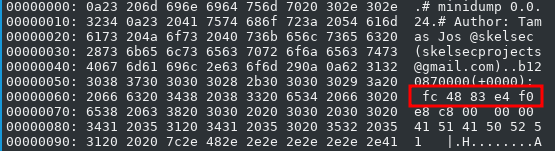
The region at 0xb120870000 starts with fc 48 83 e4 f0 — the well-known Cobalt Strike x64 shellcode prologue:
FC→CLD(clear direction flag)48 83 E4 F0→AND RSP, 0xFFFFFFFFFFFFFFF0(16-byte stack alignment)
$ minidump -r 0xb120870000 notepad.DMP 2>/dev/null | xxd | head -10

00000000: 0a23 206d 696e 6964 756d 7020 302e 302e  .# minidump 0.0.
00000010: 3234 0a23 2041 7574 686f 723a 2054 616d  24.# Author: Tam
00000020: 6173 204a 6f73 2040 736b 656c 7365 6320  as Jos @skelsec
00000030: 2873 6b65 6c73 6563 7072 6f6a 6563 7473  (skelsecprojects
00000040: 4067 6d61 696c 2e63 6f6d 290a 0a62 3132  @gmail.com)..b12
00000050: 3038 3730 3030 3028 2b30 3030 3029 3a20  0870000(+0000):
00000060: 2066 6320 3438 2038 3320 6534 2066 3020   fc 48 83 e4 f0
00000070: 6538 2063 3820 3030 2020 3030 2030 3020  e8 c8 00  00 00
00000080: 3431 2035 3120 3431 2035 3020 3532 2035  41 51 41 50 52 5
00000090: 3120 2020 7c2e 482e 2e2e 2e2e 2e2e 2e41  1   |.H........A
Q8 — Provide the C2 server IP address.
Answer 101.10.25.4
To extract network artifacts from the malicious process dump we run strings and filter for IPs and URLs:
strings -a update.DMP| grep -iE "https?://|ftp://|\b\d{1,3}\.\d{1,3}\.\d{1,3}\.\d{1,3}\b" | less -S
This extracts all printable strings and filters for IP address patterns and common protocol prefixes, revealing the hardcoded C2 address embedded in the update.exe payload.

Q9 — Provide the name of the C2 framework used by the threat actor
Answer Cobalt Strike
We found the answer on Q7 in injected shell code, when we analyze it we see on hex bytes the pattern fc 48 83 e4 f0 which is a known cobalt strike shell code
This was already identified during the shellcode analysis in Q7. The region at 0xb120870000 opens with the byte sequence fc 48 83 e4 f0, which is the well-known x64 Cobalt Strike stager prologue:
FC→CLD(clear direction flag)48 83 E4 F0→AND RSP, 0xFFFFFFFFFFFFFFF0(16-byte stack alignment)
This is one of the most recognizable signatures in memory forensics and is characteristic of Cobalt Strike’s default shellcode template